
System 3 Thinking
In Thinking Fast and Slow, Kahneman (2011) popularized the distinction between System 1 and System 2. There are always problems with simplified models. They’re simple. But they can be useful.
Shaw and Nave (2026) give us System 3 thinking, which involves the artificial intelligence as the origin of thinking.
The chart below is helpful to visualize the distinctions.
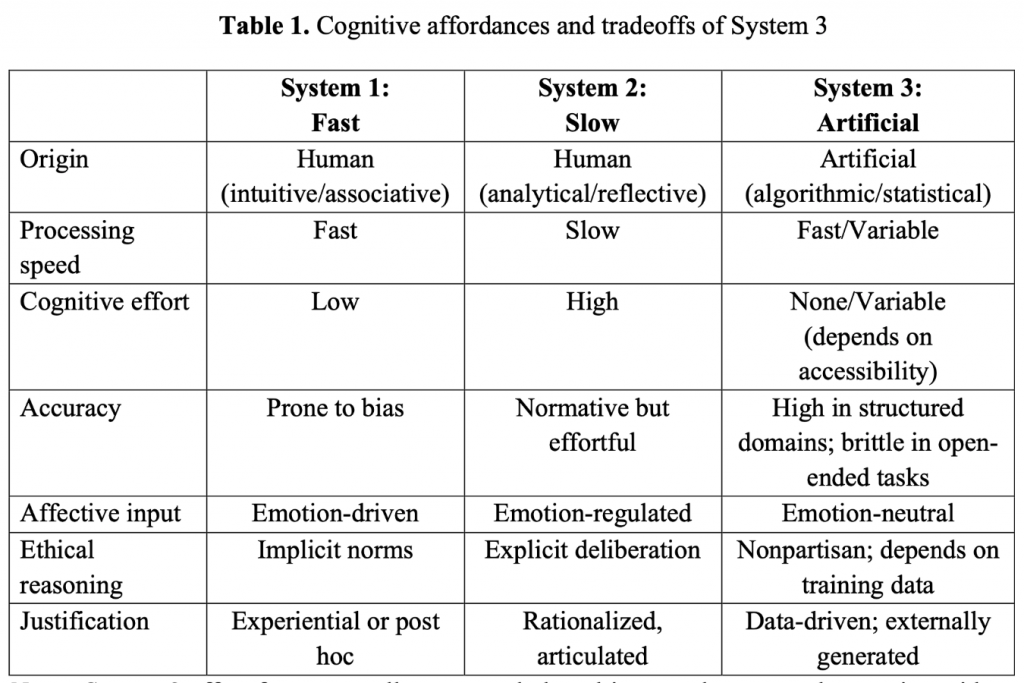
Processing speed for System 1 is fast. In System 2 it’s slow. That’s on brand.
System 3 features fast and variable thinking.
Cognitive effort in System 1 is low, System is high, and System 3 is notable because it’s None or Variable. In terms of accuracy, System 1 is prone to bias, System is normative but effortful, and System 2 is highly accurate in structured domains, and brittle in open-ended tasks.
The affective input for System 1 is Emotion-Driven, in System 2 it’s Emotion-Regulated (somebody notify the networks of neurons to affect anxiety!), and in System 3 it’s Emotion-Neutral.
Okay, well, I’m not the one defining System 3, but on some things like Ethical Reasoning as Nonpartisan (depends on training data)….I squint and say, well … maybe. I don’t know.
But, I reckon that most human generated data is dripping with partisan framing. But okay. Let’s just see where they’re coming from and continue.
Cognitive Effort: None
In a liberal democracy, we all get the chance to live the lives we want to live.
Freedom from fear.
Freedom from thought.
You can lead a horse to water, but you can’t make them drink. You can lead a person to data, but you can’t make them think.
If people want to live thoughtlessly, they have that freedom.
It’s the convenient way to experience life.
People demand convenience.
And inventors supply it.
Thoughtless Thought Leadership
Convenience is a great bet.
Entire commercial empires are built from it. The water tap, the light switch, central heating … DoorDash … OpenClaw.
Why should I go all the way to the well and haul water back to my log cabin? Why can’t it just be pumped directly to me? And bring me food while you’re at it, too! And make it so that I don’t even need to use the app to order it. It should just know what I’m in the mood for!
That’s progress.
Just as I’m certain that just as my ancestors are horrified that my fire making and fire keeping skills are severely degraded, what, with the electromagnetic force at my command, I too, may be experiencing horror that people won’t even think for themselves. As though fire skills way back then were as common as thinking skills today.
And maybe that’s a shaky assumption.
Effort used to be a barrier to entry unto itself. Most ideas never survive the shower. Fewer still survive contact with the business planning and simulations. Even fewer the first week of coding. It used to take a lot of work to invent anything, and considerably more work to invent anything worth inventing.
The monetary cost of writing (certain forms of) software, words, video, and audio has collapsed. So there’s a lot more of it. I’ve seen multiple demos in the past 120 days wherein a person doesn’t even need to do much to conceive a social media post, an asset, and just blast it out to the platforms.
It’s never been more convenient to post so much thought leadership, thoughtlessly.
Never in the field of human communication as so much been said, about so little, by so many, to so few.
It’s an old meme
We’ve been mired in thoughtlessness since before The Enlightenment.
It’s been worse. It’s easy to defer to authority. It’s harder to argue. It’s harder to think of the idea that life on Earth could be made somewhat better. Most people didn’t care. What difference did it make if the Earth went one way and the Sun went another? What difference did it make that cannon balls behaved in certain ways when dropped, as opposed to getting shot? I’m hungry now, dammit!
Thinking hard is hard, and often, it’s hardly rewarding.
Some people do find the energy to react to assaults on the status quo. They instinctively defend it. They burned people at the stake. And I continue to be warmed by the heat of their bodies. People, with help, combust. Ideas don’t. Some ideas already shine brightly.
I was far happier when I didn’t know as much about how the world cooperates just barely enough to generate a semblance or an illusion of what we might perceive as state of working. There’s a reason why you’re happier at 4 than you are at 8. Double the life, double the misery. 16, 32, 64. And because there is little incentive built into the system to be disagreeable about reality, there’s little disagreeability. The incentive for ignorance, to not pay too much attention to things, is huge. It may be mostly upside.
People generally respond to the incentives that they’re presented with and play the games they can play. People generally do their best. The megatrend is towards convenience.
It’s explainable.
Thoughtfulling
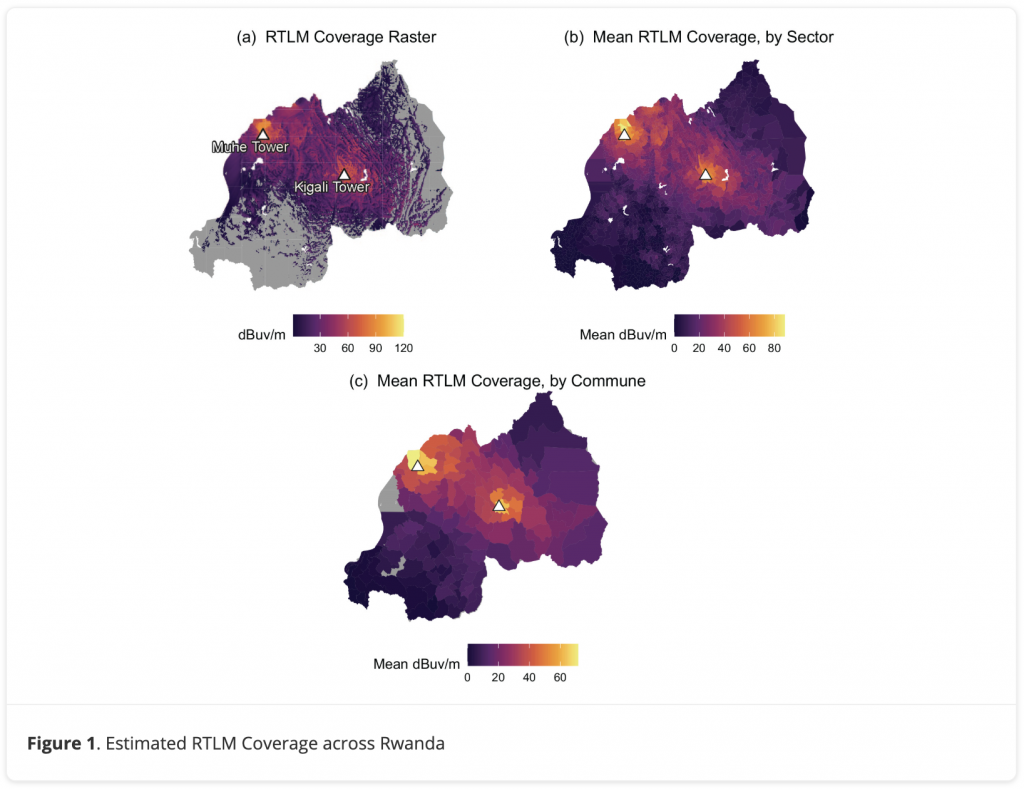
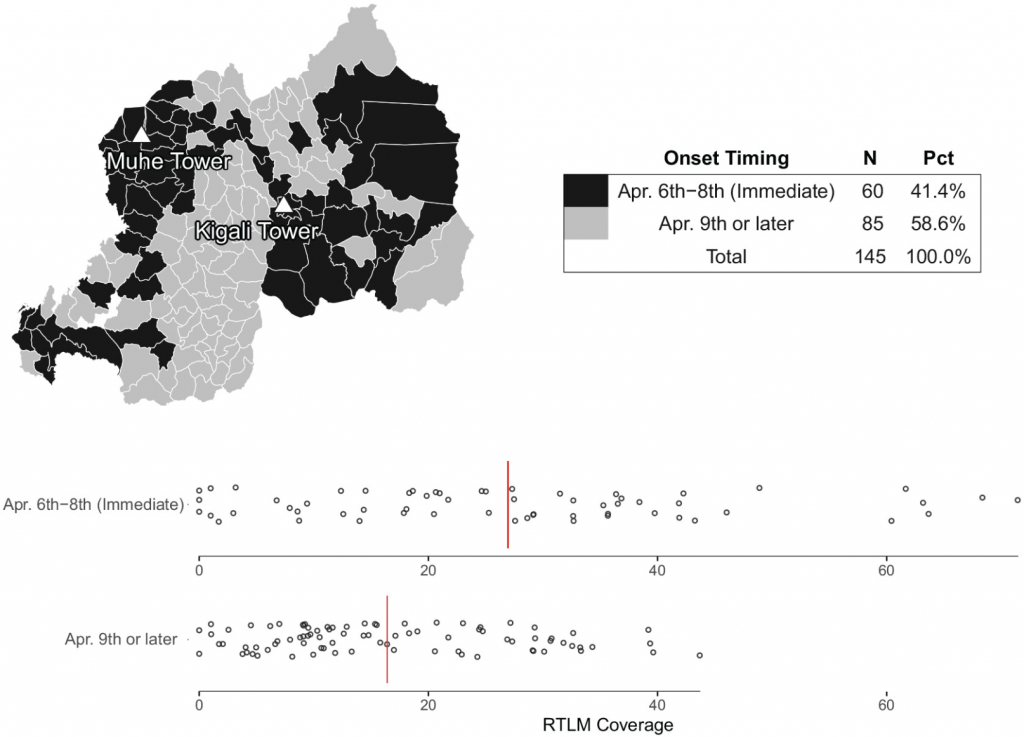
Media drives behaviour. At the most extreme, there’s good reason to believe that radio drove more killing in Rwanda (Nyseth Nzitatira, H., Billing, T., & Edgerton, J. F. (2024)) [1].
I suspect that the radio was used to transmit fear, suppressing System 2 thinking. Morally, I reckon, we regard violence committed in a System 1 state to be considerably worse than violence committed in a System 2 state. Large populations are considerably easier to inspire when they are in collective System 1 state, but are significantly harder to coordinate.
The way LLM’s have been commercialized, with a chat interface that blurs the distinction between the way a human might talk and next best token generator publishes text, mimics social media. In many ways, it’s more Facebook than Radio Rwanda. It’s why when we speak of the alignment problem in AGI research, sometimes we aren’t necessarily referring to LLM’s spontaneously killing humanity, but rather, of some LLM designer aligning the LLM to inspire susceptible humans into killing other humans at scale.
In this way, I’m not necessarily convinced that System 3 thinking is entirely without partisan bias.
And the state transition from System 3 to System 1 seems, at this point, under-studied.
Choices
You get to decide.
I’ve decided that, even in March 2026, I’m still hand planting my own words in this space. A mind is a wonderful thing to change. This is a great medium for change. Even though I could turn over all of this content to a helpful LLM to write for me, my fingers continue to fly across the keyboard. Nah, I’m good writing like this. I’m good.
If you’ve decided to read these words in April 2026, and, mayhaps, beyond that, then you too, got to choose.
Some will no doubt choose to System 3 think about these words. Ugh, 1300+ words, I’m not reading that. Into the LLM you go! And out comes a summary. And that’s a choice.
In a liberal society, you get to choose.
And that’s the point.
Notes and References
[1] Rwanda is mountainous. Mountains are rocks. Radio has a tough time propagating through rock. The structure of the mountains is, from a social science perspective, is effectively randomized. Overlay where the radio towers were, the medium and the message, with the death data, and a terrible commentary on humanity emerges. Behold the power of media.
Kahneman, D. (2011). Fast and slow thinking. Allen Lane and Penguin Books, New York, 2.
Nyseth Nzitatira, H., Billing, T., & Edgerton, J. F. (2024). How radio affects violent conflict: New evidence from Rwanda. American Sociological Review, 89(5), 876-906.
Shaw, S. D., & Nave, G. (2026). Thinking-Fast, Slow, and Artificial: How AI is Reshaping Human Reasoning and the Rise of Cognitive Surrender. Available at SSRN 6097646.