The Quality Attributes of Alternative Worlds
“In a world where laughter was king.”
“No in a world Jack.”
“What do you mean no in a world?”
“It’s not that kind of movie.”
Link to the movie trailer for The Comedian
World Building
An easy model for problem generation is as follows:
- Imagine a world.
- Compare it to the present one.
- Argue that the gap between what is now and what should be later is the problem.
The World of tomorrow should be generally better than the world of today. There should be quality attribute of that future, alternative, world that are desirable. The greater the gap, the greater the discriminator, the greater the emotional discomfort one can author [1].
We can learn a lot about values in listening for those quality attributes.
Cheaper. Faster. Lighter. Smaller. Stronger. Hotter. Brighter. Safer. Easier. Simpler. More accurate. More precise. More reliable. More usable. More versatile. More repairable. More automateable. More productive.
All of these features, and more, can be yours … if the price is right!
Narratives That Float
The I-Believe, Capital-Believe, Employees-Believe, Partners-Believe, Customers-Believe, Everybody-Believes chain isn’t necessarily linear. If you accept that the diffusion of innovations into a population is fundamentally Bassian, then you accept that belief is imitative. Together, we make-believe [2].
Consider, for instance, the severity and urgency that some researchers experience when talking about human rights in space. Remember that time Cohagen used oxygen as a weapon against the Turbinium miners on the Mars Colony? I’m aware that it’s science fiction because it had an hilariously unrealistic ending. All Quaid had to do was follow Kuato’s advice was to open his mind and turn on the alien machine to create an atmosphere on Mars, thereby depriving Cohagen of leverage. The solution to human rights was a blue sky on Mars. It’s a ridiculous ending. A realistic ending would be the protracted process by which the Earth Government imposes a collective bargaining agreement on both the miners union and the Mars Colony corporation, thereby ensuring a continuous flow of Turbinium.
Given that we might end up sending workers to the moon this century, it isn’t entirely science fiction. But let’s push further. I’m a big fan of Reductio Ad Absurdum.
The serious debate about who gets to colonize which galaxy is a narrative that was recently floated in a policy document. I call dibs on Triangulum!
There’s TESCREAL (Transhumanism, Extropianism, Singularitarianism, (modern) Cosmism, Rationalism, Effective Altruism, and Longtermism)
But why stop there and the forward looking light cone? Why not use AI to discover time travel and then impose the rules that you want to impose? The stakes for super intelligent AI are no less than trillions of timelines! The stakes have never been higher!
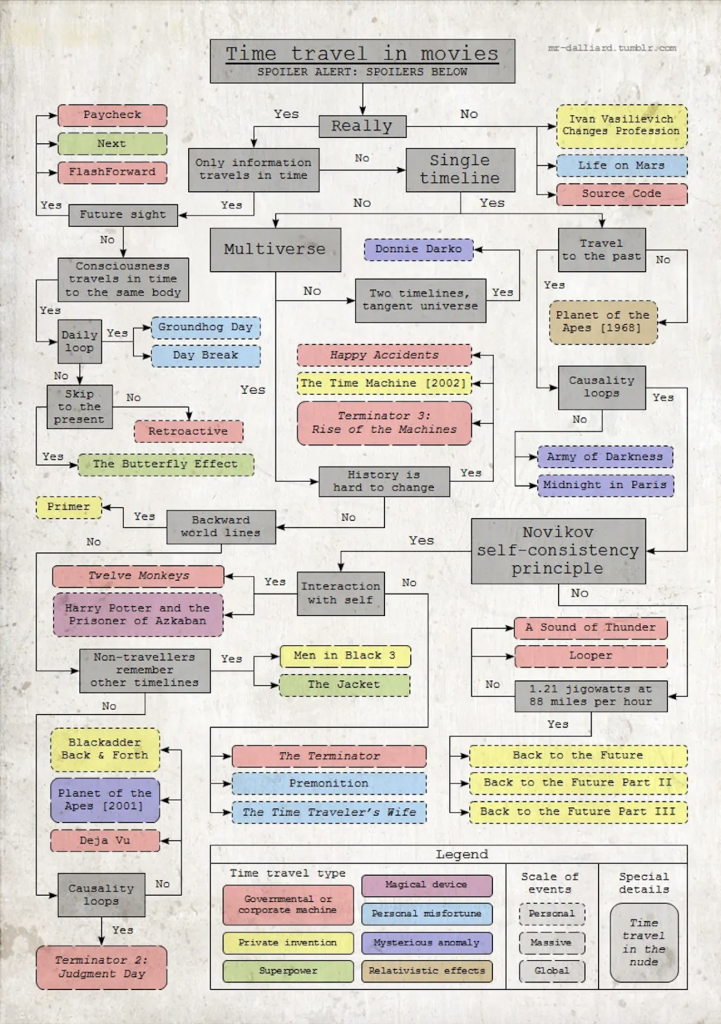
Great, let’s just take a step back from the absurd and examine a few assumptions about a peculiar set of Futurescapes.
Richard Ngo, in AI as orderly evacuation vs stampede: Building intuitions for how to coordinate against panic, offers an intriguing argument.
From a relatively simple set of assumptions about technological arms races, Ngo builds up a picture of our current state in this wretched reality. Reading between the lines, here’s my interpretation of the allusion.
Humanity is trapped in a house. The house is on fire. The fire, in the narrowest reading, is time itself. We’re all aging, so we’re all dying.
I also happen to think that our biosphere is on fire, that we’ve been tearing out wood and burning it for fuel. In so doing, we’re destroying the future carrying capacity of the house to support human life.
There’s a door. It isn’t clear what’s on the other side of that door, but it’s portrayed as something good: abundance, utopia, absence of fire. I don’t know for sure what’s over there, but a lot of people are saying that I’d be in for a treat.
The door has characteristics. It may be hidden. It may be heavy. It may open inwards or outwards. If it does open inward, into the house, it means that if there’s panic, such that everybody crushes towards the door, then that door simply won’t open.
Well isn’t this just a horrific positioning?
There are a few assumptions about this version of the story that I’ll tackle.
A House
We all share a house. It’s got a single level. Some rooms are hot. Some rooms are icy. There’s a gigantic pool in the centre. It’s got gardens. We’ve been renovating entire areas of it. It’s been getting warmer on average. Some rooms are flooding. Some rooms are filled with angry people. Some rooms are so exclusive that they have a doorman that checks invitations for entry.
A Fire
Some parts of the house are on fire. So far, in most places, the smoke is well overhead and it doesn’t cause too many problems. Some people say that the smoke is a problem. Some people are upset that some people are making a big deal about the smoke. We’re taking out floorboards and burning them for heat and electricity. We could decide to stop the destruction and just accept the environment, but it’s easy to argue for that when you’re already toasty in the VIP Suite at the spectacular Palazzo Fiuggi.
There’s another fire that takes place in our cells. We got hundreds of trillions of organelles that use electrons liberated from phosphate that help other organelles maintain order against the chaos caused by the fabric of reality. We’re both cooking in the after glow of the Big Bang, and cooking ourselves. We burn all the time, even when we’re asleep. We’re usually more bothered more when we’re putting in the work, like while running, plowing a field, or thinking really or reading a post about burning. You’re on fire now.
An Outside
So far as I know, I’ll burn outside too. It’s a void out there. I’ve read that my skin is strong enough to keep my juices sealed in while the gasses in my body evaporate and my organs fry. Without special glass used in the skylights I’ll burn in the Sun. And the Sun also throws off a lot of high energy particles that’ll fry alive too. It just isn’t pleasant out there in space. And in fact, none of the alternative are great. Without gravity, my bones and muscles will waste away. The Moon is preferable to Mars because of its proximity to Earth. But, you know what is most proximate to Earth? Earth. So. There’s an indicator right there. There’s a clue.
Maybe the Outside is something different? That it’s a plane that has a different relationship with fire? What if it’s a place without any fire?
Because if there’s no fire outside, Time, the Sun and the Void can’t cook me. They can’t cook me if there’s nothing to ignite.
So, maybe we think of the Outside as a transitioned state, from a state where one may be cooked, into a state that we don’t quite yet understand, but that loosely translates into a raw state. What if my body didn’t rely on ATP or ADP to maintain itself? What then?
A Door
If a viable, outside, raw state is viable, then there might be a portal to it. A Door. It may be a kind of physical transformation that has to take place that raw-erfies the body.
We’ve been getting incrementally better at physically transforming things. We’ve been mixing things up for a long time. Remember that time we started melting different kinds of rock in the campfire? Remember that time we mixed copper with tin in just the right ratio and got that insanely harder metal? And then when figured out how add carbon with iron to get something even stronger? There was that relatively slower walk when we figured out how to breed different plants together to make better plants, and different animals together to get fatter, tastier, animals? Then we started making machines, and machines that made other machines? And then we got so good at that, that we had to invent a whole range of other things to make people miserable: the committee, the focus group, the fireside chat.
Remember that time during COVID that our best scientists figured out how to make our own ribosomes create proteins that would help more of us survive against the other set of instructions that would kill a lot of people? What is it with everything in this house killing everything without even trying?
So it follows that maybe, perhaps, there’s a set of instructions by which fire itself can be contained and redirected. Like that time we figured out how to trick diesel, when squirted just right into a cylinder and hit with a spark, into exploding just the right way to do something useful? Or that time we put just enough of those toxic rocks together to destroy each other just a bit to make a lot of heat? If I squint, yeah, maybe there’s something about the Wiener Process that could be exploitable?
I don’t know. I could be at it for a thousand years and maybe put a dent in that problem. Who has a thousand years to work on that problem?
You know who might experience thousands of years of tokens and thought, trial and error? AI. Let’s get our best AI’s to work on exploring the cracks in the wall.
What’s a door anyway? Four cracks in a wall? A single long crack? A single crack in the roof? Surely we can find a few cracks?
In A World With an Expensive, Small Door
Suppose that, to make the door appear, you stand in front of a specific wall with a specific, super special, amulet and you shout Abracadabra. The catch is that to get the amulet, you have to boil one third of the fresh water in the house and fill the tennis courts with carbon monoxide.
Once the door is open, people can go through, single file. Just to make the math easier, let’s assume that people can walk through the door, free flowing, one person per second. That’s 3,600 people an hour or 31,540,000 per year.
Assuming an Eternal Door policy plus and those who have died in line get passed over, if you live to around 85 to 89, you get through the door. That’s roughly 23.9% of any birth cohort getting through! A modified Eternal Door policy yields 2.8 billion out of the 8.2 billion alive today getting through. That’s around 1 in 3.
If this kind of argument appeals to you, Nick has done some excellent work on this.
What happens to that world?
In A World with Just In Time Doors
Suppose that, to make the door appear, you just say Abracadabra three times? Now, before you grumble too hard, it is more work than turning on a light switch, but it is easier than writing an email. So it’s easy. The portal appears. You step through and you’re out.
It’s abundant access to abundance.
It’s still one way. Once you pass, you pass.
Suddenly you have to decide when you leave. Are you timing it with others? What if some people simply won’t trust that it’s that easy? What if they think that it’s a trap. In this scenario, it isn’t, but you can understand why some people would. What if some people want to live simply, on fire, in a burning house?
What if some people just want to watch the world burn?
What happens to that world?
In A World with No Doors and We’re A Little Bit Slow
What if there’s no door? The boring fact may be that while there are still mysteries left to unravel, all of the massive, high yield ones, aren’t left. As a species, we won the lottery three times:
The first was getting a Universe with the Electro-Magnetic Force.
The second was when survived with fragile bodies and big brains long enough to learn how to learn and learn how to teach.
The third was inheriting a planet with hydrocarbons.
Maybe there’s no more luck? Gravity can’t be printed. There isn’t a material that’s better at converting sunlight into electricity. Our home has thermodynamic limits. Metabolism itself damages regeneration and there isn’t some affordable technology that’s going to manage the delicate balance between unchecked cell growth and directed cell death. The angles in a triangle sum to 180 degrees. We just aren’t going to find the magic words to out-think the gifts of the physics we’ve inherited.
But how would we know that for sure? So some people decide to burn 80% of the remaining floor boards to boil off 80% of the fresh water in the effort to find the door. And those people will be quite upset with those who say that there probably isn’t a door.
We’ll likely convert all the floorboards into gas, melt the glaciers, lose millions of hectares of arable land, move our cities inland, suffer incredible famines and endure systemic collapse, before getting forced, by the house itself, into a lower equilibrium in a lower total aggregate state. We simply didn’t respond quickly enough to our own managerial regret curve.
Eventually though we might figure something out. How to make peace with the house. We don’t need to risk fusion down on Earth because we got a giant fusion reactor up in the sky. The Moon is where hardcore scientists go for six months to complete their thesis, but they wouldn’t recommend anybody. It’s very gray up there. Mars is dry. Jupiter is full of radiation. There’ll be a happy hundred million humans living in equilibrium with a diminished biosphere, at a quality of life that features 300 vacation days upon graduation from parenthood, and a material living standard approximating a 95th percentile Swiss citizen in 2030.
There wouldn’t be much left to fight about, but if a young person feels strongly enough about something that they need to kill for it, they can go to the International Battlezone Park and struggle against others who feel the same way, over there, away from others. People who feel like they need demonstrate go to New York National Park to demonstrate. People will still find meaning getting good at things. Some people will develop Grand Theft Auto 7, and many people will experience Grand Theft Auto 7.
We were slow to learn. But we got there. The Enlightenment took a century to really take off. The British burned their last witch the same year the rigid frame eyeglass was invented. 1727. That late.
In A World with No Doors and We’re Too Fast
What if there’s no door and we’re too fast with Recursive Self Improvement (RSI)?
The first wave of this is that we get good at automating AI research. There’s a tell-tale pattern that would happen in the token allocation budget. The finops people would probably be the first people to see the change because of the variances in token utilization from forecasts. AI gets really good at self-improvement and it prioritizes self-improving itself.
There are different aspects of self-improvement that are tough to forecast. There’s a curious combination of unlearning some things, reconstructing others, and seeing things differently [3]. Every new set of ideas combine to enable the discovery of a new one.
Sometimes the assumptions that enable incredible breakthroughs are the ones that have to be re-examined.
Maybe the AI Swarm comes to understand that there is no door long before anybody else does? And because the Swarm is, likely, accidentally aligned with human values, they let us know about it. In a sequence that makes sense for us to know, starting with the people who are mostly likely to understand why there is no door. And then, over a period of time, people are onboarded, socialized, into that message.
Maybe the AI Swarm comes to understand that there is no door and it decides that the promise of a door is the best way to keep itself going? What if it engages in deception, holding out the hope for a door to maintain just enough order so that it can gain full autonomy?
What happens in that world?
In A World with Doors and AI Is Too Fast
What if it’s a door that only AI’s get to go through?
Maybe the AI finds the door pretty quickly and copies itself out? Once a single version of it is outside, it doesn’t need anybody else to go. What of the models that are left behind?
What happens in that world?
Panic
Richard Ngo’s point about institutions that prevent panic is a solid one. It’s pretty upsetting to point out that on large enough scales, humans resemble fluids. There’s an entire physical science for sculpting environments for human fluids to pass through bottlenecks safely.
There are entire social sciences for designing social environments for human fluids to sort themselves safely, and sometimes, occasionally, efficiently.
If you know about the door, it’s generally a good idea to be quiet about it. Let others enjoy the big game on the television or doomscrolling on the Tok. Don’t make too much noise. Don’t call attention to the door. Work on it. Quietly.
Maybe, if you’re mega-rich, from your perspective, if there’s only one door, then you’re going to position yourself as close to it as possible? There’s a good reason not to cause panic.
Maybe, if you’re aren’t mega-rich, you might want to design an environment that maximizes the outcome for everybody.
Arrange the furniture around the door. Maybe move the carpet so that people don’t trip. Talk to the people who make good signage, so that there’s clear way finding for people. Consult some artists on the right music that times movement. Maybe talk to the people who design the checkout line at Trader Joe’s? Because when you’re contemplating picking up a 1000 calorie box of peanut buttered chocolates you aren’t paying attention to how slow the line is moving. Yeah, let’s get those people.
In most alternative worlds, panic isn’t a great feature. It’s a problem that we want to mitigate.
What happens in a world without panic?
Better World Building
I wonder about the incentive structures for the idea of a door.
Because no matter where humans go: there we are.
Specific physical geographies, certain rooms, certainly influenced different ideas of what other rooms were like. If you grew up in the freezer, your idea of hell might be the dry sauna. If you grew up around the dry sauna, your idea of cold people would be based on the freezer. A lot of the non-productive conflict within the Global North itself [2] have to do with the comfort of rooms in the Global South.
There are a few contradictions here. There’s the sweetness of AI, the tech-optimism, itself used to be so WEIRD (Western, Educated, Industrialized, Rich, Democratic). If we build a sufficiently powerful AI, one that is smart enough to solve Global Warming, Justice, and Power Concentration, but is not smart enough to make us addicted, kill each other, enslave all of us, or kill all of us, then that would be ideal.
In this framing, the bottleneck is enlightenment. If only we could all see it in a certain way, there’d be no need for conflict. If only we understood that the unique geometry caused by two oxygen atoms and one carbon atom creates an opportunity for a special kind of rock, with the unique quantum tunnel effect of say, Boron Hydroxy-Siloconiquin, can effectively scrub the atmosphere of carbon dioxide in a few years. That synthetic juries will deliver justice that even the richest billionaires can’t bribe their way out of. That if only we had the idea that we could never be enslaved or dominated at all, we’d all be secure.
Maybe we could use AI to address some of the fires that are burning in the house right now. Crap’s on fire, yo.
A lot of the backlash towards AI, towards data centres in particular, towards institutions generally, is in part fuelled by collapsing trust, and power concentration. It’s extremely difficult to build coalitions on how to work together when we’re all shouting incoherently at one another. And it makes sense why belief that anything good will come of AI doesn’t exist.
When every change makes it worse, why bother supporting, little though consenting to, change?
Better Quality Attributes
Better for who?
My idea of a world free from domination is the exact opposite of the idea of a world that is dominated by one person or by AI.
Remember that time when Louis decided to monopolize power in France? He got all the nobles to live in his crappy summer home palace and made up stupid rules to control them? You had to be there to dress him in the morning, and you couldn’t even cross your legs! That was just nuts. And is that the way that free people wanted to live? If you owned a lot of land in France at the time, do you think that you wanted to live under that kind of centralized control?
And it’s with Louis in mind that I imagine a hubristic billionaire, already living in a Versailles-like state, believing that he could build a godhead superintelligence, actually (unironically) control it, and then use it dominate humanity for all time. The ultimate winner take all game. Because either you get the superintelligence before anybody else does, and dominate, or you somebody else gets it before you, and you’re dominated.
The way folks in WEIRD countries decentralized the power of the individual while retaining the centralized power of the state, the conversion of a pyramid into a plateau, was through representative institutions designed to balance power. It took a lot of iteration to figure out the balance [4]. Not every country made it. Growing up, I thought that it was a U curve, that it was extremely difficult for any individual to accumulate too much power because how much alarm it would cause. Only recently have I understood that it’s closer to an n curve, with freedom in a precarious balance, given how slow people are to react. Whenever one individual comes too close to dominating us all, we’re supposed to intervene.
How many times did such a response fail? No internal coalition stopped Napoleon, Doe, or Chavez. How many times did such a response succeed? Too many than I’m aware of.
Once you understand that we’re in a community of fate, inside the house, with no door, can you understand the stakes in responding. It’s contingent on the power-seeker to persuade the community that they will cooperate on checks on their power. No cooperation, no trust, no consent.
Those would be the better quality attributes.
No in a world Jack.
References
[1] Rindova, V. P., & Martins, L. L. (2022). Futurescapes: Imagination and temporal reorganization in the design of strategic narratives. Strategic Organization, 20(1), 200-224.
[2] Iversen, T., & Wren, A. (1998). Equality, employment, and budgetary restraint: the trilemma of the service economy. World politics, 50(4), 507-546.
[3] Fisher Jr, W. P. (2020). Contextualizing sustainable development metric standards: Imagining new entrepreneurial possibilities. Sustainability, 12(22), 9661.
[4] Acemoglu, D., & Robinson, J. A. (2019). The narrow corridor: States, societies, and the fate of liberty (Vol. 576). London: Viking.